
What Are the Best Shrink Sleeves From China?
Choosing the best shrink sleeves from China requires more than comparing prices on a supplier page. The right choice depends on film quality, shrink performance, printing accuracy, and production consistency. A sleeve may look sharp under showroom lights, yet wrinkle around a curved bottle during heat application. That small failure can damage an entire launch.
Packaging expert Lisa McTigue Pierce offers a useful reminder: “Packaging is not decoration; it is part of the product experience.” Her point applies directly to shrink sleeves. Chinese manufacturers now supply PETG, PVC, OPS, and recyclable sleeve options for beverages, cosmetics, household products, and specialty packaging. However, material claims need careful verification. Ask for technical data, migration documentation, color proofs, seam samples, and actual trial results. Do not rely only on attractive photographs.
In this guide, we examine suppliers through practical criteria: film clarity, shrink ratio, ink adhesion, registration accuracy, delivery reliability, and quality control. We also consider whether a factory can handle small test orders before committing to large volumes. Some manufacturers offer impressive equipment but weak communication. Others provide excellent printing but limited support during application. That is easy to overlook.
The best shrink sleeves are not automatically the cheapest. They should fit the container, survive transport, and support responsible end-of-life decisions. Even this evaluation has limits. Supplier capabilities can change, and sample quality may not represent every production batch. Careful testing remains essential.
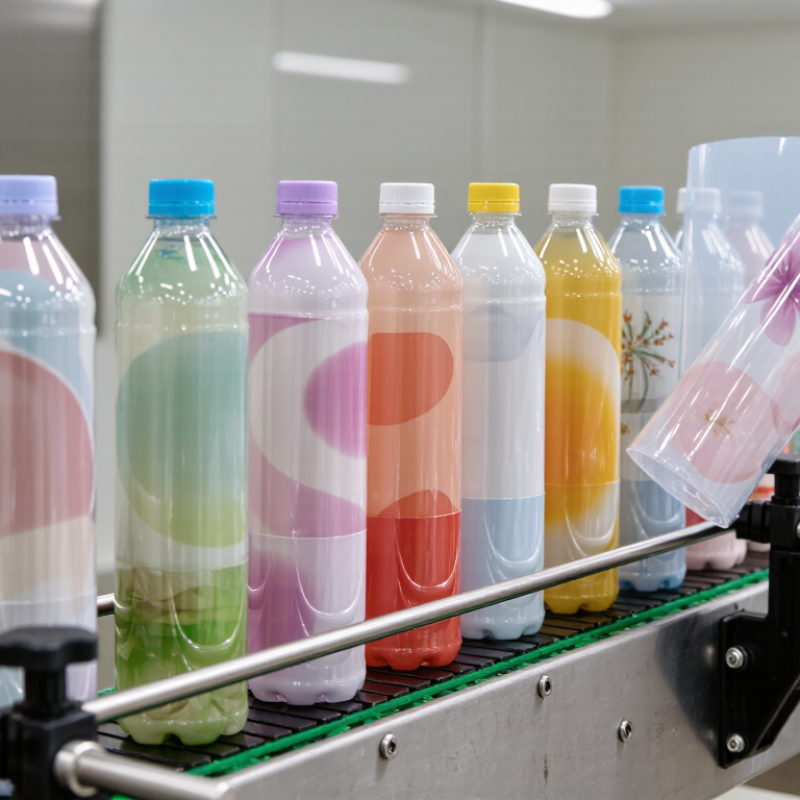
Table of Contents
[Hide]
Types of Shrink Sleeves Manufactured in China
What Are the Best Shrink Sleeves From China?
China manufactures several shrink sleeve types, each suited to different packaging conditions. PETG sleeves offer strong shrink performance, often reaching 70% or more, according to technical data reviewed by packaging engineers. They fit curved bottles and complex containers well. PVC sleeves provide clear printing and stable processing, but recyclability concerns require careful material selection. OPS sleeves are lightweight and create a premium, smooth appearance. PLA sleeves use plant-based feedstock, although heat resistance and supply consistency can vary.
China also produces roll-fed sleeves, pre-cut sleeves, and tamper-evident neck bands. Roll-fed sleeves support efficient high-volume production. Pre-cut versions suit smaller runs and varied container sizes. Tamper-evident bands help show whether packaging was opened. Grand View Research estimated the global shrink sleeve labels market at about 14.4 billion US dollars in 2023, with continued growth expected through 2030. This demand encourages Chinese factories to improve printing accuracy, seam strength, and shrink testing.
Tips: Request samples on your actual bottle. A sleeve that works on a straight cylinder may wrinkle around the shoulder. Check shrink temperature, ink adhesion, seam placement, and recycling compatibility. Smithers’ packaging research repeatedly emphasizes downgauging and material efficiency, but thinner film is not automatically better. In production audits, small registration errors can become obvious after shrinking. I have found that suppliers sometimes quote ideal shrinkage, not practical line results. Ask for test videos and measured data before approval.
What Are the Best Shrink Sleeves From China? - Types of Shrink Sleeves Manufactured in China
| Shrink Sleeve Type | Typical Material | Typical Transverse Shrinkage | Typical Shrink Temperature | Main Advantages | Common Applications | Important Considerations | Best Use Case |
|---|---|---|---|---|---|---|---|
| PVC Shrink Sleeves | Polyvinyl chloride film | Approximately 45%–65% | Approximately 60–80°C | Good printability, strong clarity, wide processing tolerance, and generally economical production | Beverage containers, household products, personal-care packaging, and promotional labels | Contains chlorine; it may be unsuitable for packaging systems designed for PET recycling and requires suitable ventilation during processing | Cost-sensitive products requiring attractive graphics and moderate shrink performance |
| PETG Shrink Sleeves | Polyethylene terephthalate glycol-modified film | Approximately 70%–80% | Approximately 70–90°C | Very high shrink capability, excellent clarity, strong graphics, and good conformity to complex bottle shapes | Contoured beverage bottles, health-care containers, cosmetics, and premium consumer packaging | A PETG sleeve can interfere with PET bottle recycling if it is not designed for easy separation or removed before recycling | Complex-shaped containers where maximum coverage and high-quality decoration are priorities |
| OPS Shrink Sleeves | Oriented polystyrene film | Approximately 50%–70% | Approximately 80–100°C | Low density, good dimensional stability, smooth shrinking, and strong suitability for high-speed labeling | Food packaging, beverage containers, and products using high-speed sleeve applicators | Requires controlled heating; excessive temperature or uneven heat can cause wrinkles, distortion, or poor registration | High-throughput applications needing lightweight sleeves and consistent machine performance |
| PE Shrink Sleeves | Polyethylene film, commonly oriented PE | Approximately 50%–70% | Approximately 90–120°C | Good flexibility, impact resistance, moisture resistance, and compatibility with flexible plastic containers | Household chemicals, refill pouches, squeeze bottles, and containers made from polyethylene | Usually less rigid and less optically clear than PETG; the sleeve and container should be matched for recycling compatibility | Flexible or squeezable packages that need durable, moisture-resistant decoration |
| PLA Shrink Sleeves | Polylactic acid film | Approximately 60%–70% | Approximately 60–80°C | Bio-based feedstock options, attractive appearance, and suitability for selected compostable-packaging systems | Specialty food, beverage, and packaging projects with access to appropriate industrial composting infrastructure | Industrial compostability depends on the complete certified structure and local facilities; it should not be assumed to be home-compostable | Projects with verified composting routes and documented environmental requirements |
| Perforated Shrink Sleeves | PVC, PETG, OPS, PE, or PLA with engineered perforations | Depends on the base film | Depends on the base film | Allows controlled tearing, tamper evidence, promotional opening, or easier sleeve removal | Tamper-evident packaging, multipacks, seasonal packaging, and recycling-oriented label designs | Perforation spacing and tear strength must be tested to prevent premature splitting during transport or application | Packaging requiring convenient opening or easier separation from the container |
| Roll-Fed Shrink Sleeves | Usually PETG, OPS, PVC, or other specified shrink film | Depends on the selected film grade | Depends on the selected film grade | Efficient continuous production, reduced preform handling, and flexible label length adjustment | High-volume beverage, food, personal-care, and household-product lines | Requires accurate web tension, seam control, registration, and compatibility with the roll-fed labeling machine | Large production runs where automation and high labeling speed are essential |
| Tamper-Evident Shrink Sleeves | PVC, PETG, OPS, or PE with a neck, cap, or closure section | Depends on the base film and design | Depends on the base film and application equipment | Provides visible evidence of opening and can combine security features with full-color decoration | Food, beverages, cosmetics, supplements, and household products with closure protection requirements | The perforation, tear line, sleeve length, and heat profile must be matched carefully to the closure geometry | Products where consumer-visible package integrity is a primary requirement |
Note: Shrinkage and temperature figures are typical industry ranges. Actual performance varies by film grade, thickness, bottle geometry, printing method, seam design, and tunnel or steam application conditions.
Related Posts
-
What Are the Benefits of Using Shrink Sleeves for Packaging?
-
Top 10 Benefits of Using Shrink Sleeves for Packaging?
-
2026 Best Shrink Sleeves for Packaging Solutions and Applications?
-
Discover the Future of Packaging: Top 5 Shrink Sleeves Trends in 2025
-

Top 2025 Trends in Shrink Sleeves: Innovations and Applications Explained
-
How to Effectively Use Shrink Sleeves for Packaging?